Continual learning · OOD detection
# TOOD ### Task-Aware Out-of-Distribution Score Calibration for Continual Learners Mostafa ElAraby · Samer B. Nashed · Liam PaullCoLLAs 2026 · Oral presentation
Note: The presentation focuses on why classification retention alone does not establish reliable OOD detection. --- ## OOD detection throughout learning - A continual learner acquires new classes over time. - It must still recognize familiar inputs from earlier tasks. - It must also reject inputs outside **all classes learned so far**. > Remembering class labels does not guarantee remembering the boundary to the unknown. Note: Example: cups and plates are learned first, books and pens next. A shoe remains OOD throughout. Books become ID after their task is learned. --- ## Evaluation setting **Class-incremental learning:** disjoint class groups arrive in successive tasks.Higher AUROC is better. Positive $D_i$ indicates deterioration.
Note: AUROC comparisons use each task's ID examples against the evaluation OOD sets. The trajectory metric is different from final-checkpoint AUROC. --- ## Classification and OOD forgetting Diagnostic plots from the supplied TOOD presentation
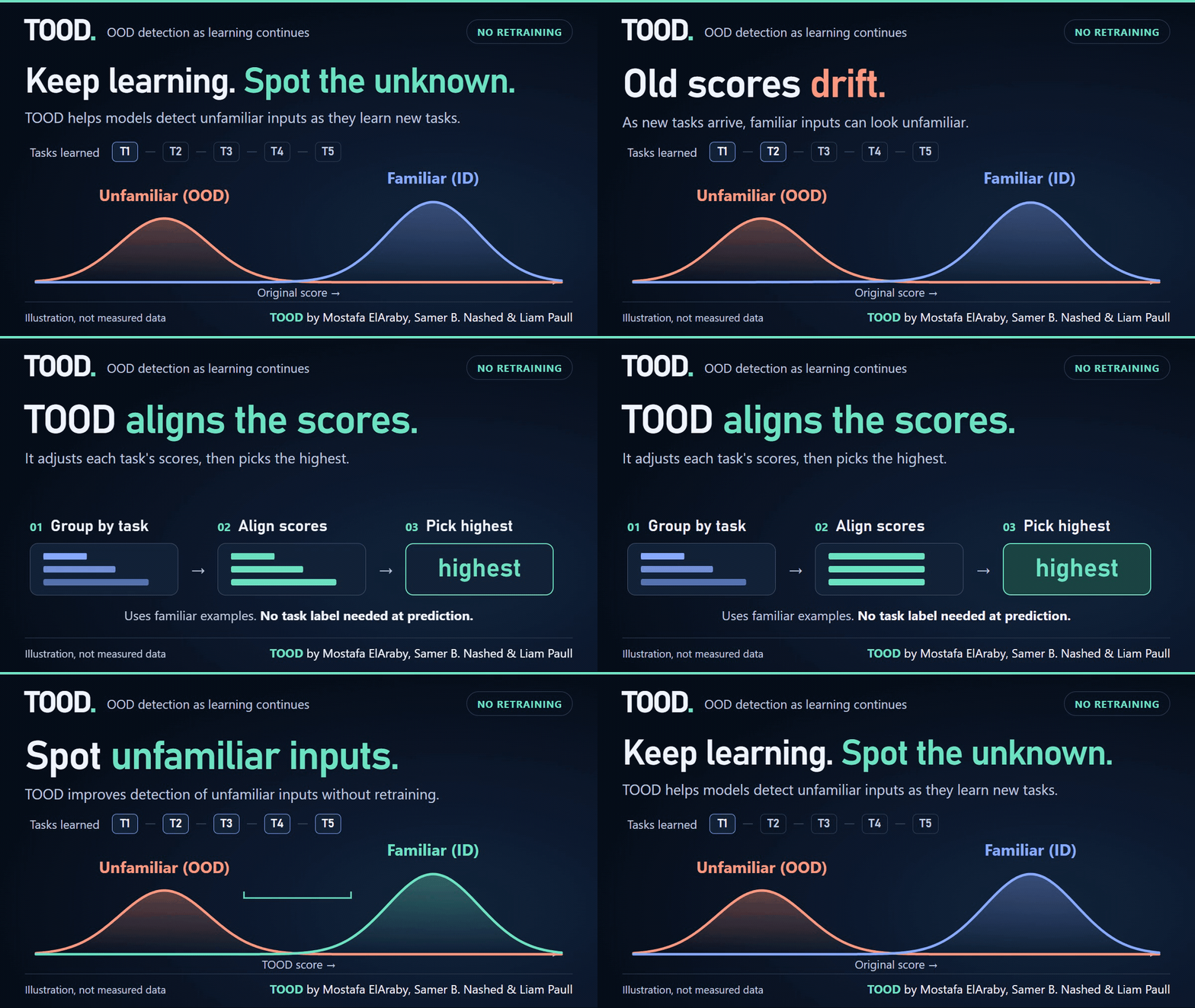
**Classification performance alone is an incomplete reliability measure.** Note: Read the original figure axes carefully: the diagnostic compares representation change with two forms of forgetting. It motivates examining output scales as well as features. --- ## Mechanism 1: the confidence gap  - Older tasks’ logit scales weaken relative to newer tasks. - Correct class ordering can survive while energy separation deteriorates. Note: This is the mechanism TOOD targets. The diagnostic follows an old task over a CIFAR-10 learning sequence; it is not an average across all tasks. --- ## Mechanism 2: manifold crowding  New classes occupy feature-space regions that previously separated known inputs from outliers. **TOOD corrects output scores; it does not restore lost feature-space margins.** --- ## TOOD: animated overviewIllustration of score drift and calibration, not measured experimental data
Note: Animation supplied from LinkedIn. It illustrates the core maximum-score variant without the optional top-two margin. Calibration uses familiar examples; the input's task label is not required at prediction time. --- ## Why a global score shift is insufficient AUROC depends on sample ranking.Requires representative ID memory and a nonzero, numerically stabilized scale.
--- ## Step 3: combine calibrated responses Core score:$\lambda=0$ gives the core score; main experiments use $\lambda=0.5$.
Note: A high response from at least one task suggests ID. The margin rewards a clear task preference. With one task, use the core score rather than a nonexistent runner-up. --- ## Calibration and inference **After each task** 1. Freeze the current learner. 2. Forward the ID memory through it. 3. Estimate and store statistics for every seen task. **For each test input** Compute task energies → normalize → maximum plus optional margin.No retraining, no OOD calibration examples, no change to class predictions.
--- ## Experimental protocol | Dataset | Learning stream | Backbone | | :--- | :--- | :--- | | CIFAR-10 | 5 × 2 classes | ResNet-32 | | CIFAR-100 | 10 × 10 classes | ResNet-32 | | ImageNet-1K | 100 × 10 classes | ResNet-18 | - CIFAR learners: iCaRL, BiC, DER, WA, LwF. - Near- and Far-OOD evaluation following OpenOOD. - ID memory: 200 examples for CIFAR-10; 700 for CIFAR-100. Note: Main CIFAR results average three seeds. The ImageNet scalability study uses one seed. ViT-B/16 appears in additional diagnostics. --- ## CIFAR-10 results Average incremental AUROC (%) · mean ± standard deviation, three seeds | Learner | Energy | Mean Shift | Robust Anchor | | :--- | ---: | ---: | ---: | | iCaRL | 65.9 ± 1.5 | 66.5 ± 1.5 | 66.4 ± 1.4 | | BiC | 67.2 ± 1.0 | **71.6 ± 0.2** | 70.6 ± 0.3 | | DER | 61.2 ± 0.7 | **69.3 ± 0.9** | 68.6 ± 0.9 | | WA | 78.1 ± 2.3 | 78.3 ± 2.1 | 78.2 ± 2.4 | | LwF | 72.2 ± 0.5 | 73.2 ± 0.3 | 73.0 ± 0.7 | **DER: +8.1 AUROC points over uncalibrated energy.** Note: Results are averaged over the learning sequence and Near-/Far-OOD evaluation, as reported in the local blog post and supplied deck. --- ## CIFAR-100 results Average incremental AUROC (%) · mean ± standard deviation, three seeds | Learner | Energy | Mean Shift | Robust Anchor | | :--- | ---: | ---: | ---: | | iCaRL | 58.1 ± 1.3 | 58.4 ± 1.0 | 58.9 ± 1.0 | | BiC | 65.6 ± 0.5 | 68.4 ± 1.3 | **68.8 ± 1.6** | | DER | 64.6 ± 1.2 | **67.1 ± 0.5** | 66.1 ± 0.9 | | WA | **71.9 ± 0.1** | 71.7 ± 0.2 | 71.5 ± 0.1 | | LwF | **67.0 ± 1.6** | 66.7 ± 1.7 | 66.3 ± 1.6 | **Benefit depends on the learner; WA and LwF slightly decline.** --- ## ImageNet-1K: 100 tasks Average incremental AUROC (%) · single seed | Learner | Energy | Mean Shift | Robust Anchor | | :--- | ---: | ---: | ---: | | BiC | 59.2 | **65.2** | 65.1 | | WA | **70.1** | 65.7 | 65.6 | | DER | 70.2 | **71.4** | 70.5 | Mean Shift improves BiC by **6.0 points** and DER by **1.2 points**. WA falls by **4.4 points**: calibration is not a universal upgrade. --- ## Scope and limitations - Requires known training task partitions and representative ID memory. - Corrects task-wise score drift, rather than feature-space crowding. - Gains vary with the learner and its existing output correction. - Evaluate detection throughout learning, alongside classification retention. > Calibrate the response to each known task before deciding whether an input is unknown. ---Questions & discussion
# TOOD [Paper · arXiv:2607.29592](https://arxiv.org/abs/2607.29592) [Code · tood-continual-ood](https://github.com/mostafaelaraby/tood-continual-ood) [Related presentation · GROOD](GROOD.html)Mostafa ElAraby · Mila / Université de Montréal
Note: Source material: TOOD paper presentation.pptx and the site's TOOD publication post. Current paper metadata is verified against arXiv. Conflicting top-two ranking counts in the supplied materials are omitted; numerical results are shown directly.